No Time Zone Headache: Why Busyexpand Teams Work Seamlessly With Europe and the US
 Ama Powell
Picture this.
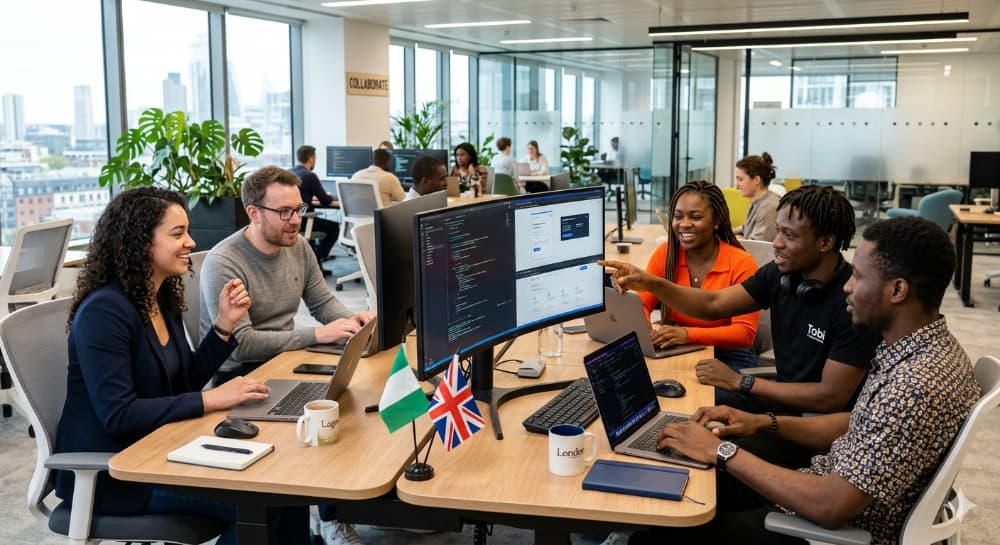
It is 9:00 AM in London. Your product manager opens her laptop, pours her first coffee, and finds a Slack message from the Busyexpand team in Lagos. The bug she flagged at 5:30 PM the night before? Fixed. Tested. Merged. PR link attached.
She did not chase it. She did not stay online waiting. She did not hold a 7:00 AM call to unblock a developer on the other side of the planet. She went home, made dinner, put the kids to bed — and woke up to a solved problem.
Now picture the alternative.
It is 9:00 AM in London. She opens her laptop. The Slack message from the Mumbai team reads: "We saw your comment. We'll look at it this morning." Their morning. Which is her 3:30 PM. Which means the back-and-forth won't resolve until tomorrow. Which means the sprint slips. Which means the demo gets pushed.
This is not a hypothetical. It is the daily reality of time zone math — and it is the reason smart companies are increasingly choosing Nigeria over the traditional offshore destinations. Not just for the talent. Not just for the cost. For something that sounds deceptively simple but turns out to be one of the most powerful workflow advantages in distributed engineering:
Nigeria's clock is almost perfectly aligned with yours.
The Hidden Tax That Nobody Budgets For: Time Zone Misalignment
Before we get to why Nigeria works, let us quantify exactly what time zone misalignment is costing teams that get it wrong.
The research is damning.
<cite index="204-1">When remote team members work in different time zones, the frequency of synchronous communication drops by 11% for every hour of separation.</cite> That is not a soft preference metric — it is a measurable degradation in the speed at which decisions get made, code gets reviewed, and problems get resolved.
<cite index="204-1">Without structured communication windows, productivity can plummet, forcing employees into late-night shifts or relying on video messages instead of live discussions, with key decisions often delayed by an entire day.</cite>
<cite index="205-1">The primary mechanism is decision latency: the time it takes to resolve questions, review code, and coordinate architectural choices. When these activities require 24-hour async cycles instead of same-day resolution, iteration speed drops.</cite> And iteration speed is everything in software development. A team that resolves blockers same-day ships features in two weeks. A team that waits 24 hours per blocker ships the same features in three.
<cite index="201-1">These gaps compound over time, inflating project timelines by up to 20% compared to in-house teams.</cite> On a six-month project, 20% inflation is five additional weeks. On a £200,000 budget, it is an unexpected £40,000 overage — for a problem that was never in the brief.
There is a human cost too. <cite index="201-1">A 2025 analysis of 12,000 offshore IT workers showed that 68% experienced chronic sleep disruption after six months of aligning with US schedules, resulting in a 14% decline in code quality.</cite>
The hidden tax of time zone misalignment is not measured in hours. It is measured in slipped sprints, degraded code quality, burned-out engineers, and the slow-motion frustration of watching a roadmap drift further away every quarter.
Nigeria sidesteps almost all of it.
The Nigeria Time Zone: The Numbers Nobody Is Advertising Loudly Enough
Nigeria operates on West Africa Time (WAT) — UTC+1, year-round. No daylight saving time. No clock changes in March or October that suddenly shift your meeting windows. No seasonal recalculation. The same, stable, predictable offset every single day of the year.
Here is what that means in practice.
Nigeria and the UK: Near-Perfect Overlap
<cite index="194-1">Nigeria is only one hour ahead of the UK, and sometimes in the same time zone when the UK changes its clocks.</cite>
One hour. That is it. When your London team opens their laptops at 9:00 AM, the Lagos team is already at 10:00 AM — mid-morning, warmed up, through their first standup. You have seven to eight hours of shared working day before either team's close of business. That is not a collaboration window. That is a full working partnership.
For context: India is 4.5 to 5.5 hours ahead of the UK. Eastern Europe ranges from 1 to 3 hours ahead, which sounds close — until March and October, when DST shifts in Europe but not in the corresponding country, and your 9:00 AM call suddenly becomes an 8:00 AM call. Nigeria has none of this variability. <cite index="200-1">Nigeria uses a single time zone year-round: Africa/Lagos. No adjustments, no seasonal shifts.</cite>
Nigeria and the US East Coast: The Sweet Spot for Handovers
<cite index="194-1">Nigeria is 5 to 6 hours ahead of the US East Coast — 2 PM in Nigeria is 9 AM in New York.</cite>
This creates something that offshore engineering veterans call the golden handover window — and it is enormously valuable.
When your New York team starts their day at 9:00 AM, the Lagos team is at 2:00 PM — five hours into their workday, with the morning's work already done. The Busyexpand team does not need to context-switch from a cold start. They have been building all morning. They arrive at the US overlap window with momentum, completed work to demo, and blockers already identified. The New York team opens their laptops to a prepared team, not a sleeping one.
<cite index="196-1">This creates a valuable morning overlap for the US and an afternoon overlap for Nigeria, forming a consistent, predictable window for real-time collaboration that you can plan around.</cite>
<cite index="198-1">Nigerian teams overlap with US business hours, facilitating seamless, almost real-time collaboration. This alignment enables Nigerian teams to start work early, delivering timely updates, proactive troubleshooting, and resolving issues before US clients even begin their workday. When teams in Nigeria start their workday, clients in the US and Europe often wake up to solutions ready to be implemented.</cite>
That last sentence deserves a pause. Wake up to solutions ready to be implemented. That is not a description of an offshore bottleneck. That is a description of a productivity machine.
Nigeria and the US West Coast: The Follow-the-Sun Advantage
<cite index="194-1">Nigeria is 8 to 9 hours ahead of the US West Coast — when your workday is starting in California, the Nigerian team is already wrapping up their day.</cite>
For companies running a follow-the-sun engineering model — where work flows continuously across time zones — Nigeria's position relative to the US West Coast is almost ideal for structured handovers. San Francisco engineers close out their day, push to a shared board, and the Lagos team picks it up first thing the next morning. No gap. No silence. No waiting for the cycle to restart.
Compared to the Alternatives: Why Nigeria Wins the Time Zone Argument
Let us put Nigeria's position directly alongside the most common offshore development destinations, because the contrast makes the advantage concrete.
India (IST — UTC+5:30)
India is the world's largest offshore engineering market. It is also, for European and US clients, a study in time zone pain.
India is 4.5 to 5.5 hours ahead of the UK and 9.5 to 10.5 hours ahead of New York. A London team's 9:00 AM standup is India's 2:30 PM — workable. But a 5:00 PM London decision does not reach India until 10:30 PM IST, after business hours. The response comes back the next morning — 12 to 14 hours of lag on every end-of-day exchange.
<cite index="201-1">A software update approved by US stakeholders at 5 PM EST won't reach Indian developers until 3:30 AM IST, creating a 12-hour lag in issue resolution.</cite>
For US teams, the situation is worse. New York's 9:00 AM is India's 7:30 PM. The working day overlap is a narrow, uncomfortable two-hour window, during which India is approaching the end of their day and the US is just warming up. Many teams that use Indian development partners simply accept that the collaboration is asynchronous by default — which means accepting the 24-hour cycle decision latency described above.
Eastern Europe (CET/EET — UTC+1 to UTC+3)
Eastern Europe is geographically and culturally closer to Western clients, and time zone overlap with the UK and Europe is genuine and workable. But there are complicating factors.
First, DST disruption: European clocks change in March and October. Countries in Eastern Europe that observe DST shift alongside Western Europe — but the shift timing sometimes misaligns with the UK or US by a week, creating temporary confusion windows that require calendar management every spring and autumn.
Second, the geopolitical environment since 2022 has materially disrupted major Eastern European engineering markets. Ukraine's developer pool — previously one of the most cost-competitive in the world — has experienced significant displacement and logistical complexity. The stability that offshore partnerships require is harder to guarantee.
Nigeria has neither of these complications. No DST. No geopolitical disruption affecting the engineering ecosystem. Stable, predictable, open for business.
Southeast Asia (Philippines, Vietnam — UTC+7 to UTC+8)
The Philippines is 7 to 8 hours ahead of the UK. Vietnam is similar. For European clients, the overlap window is a narrow slot at the beginning of the European working day — most collaboration is asynchronous by necessity.
For US East Coast clients, Southeast Asia is 11 to 13 hours ahead — essentially the opposite side of the clock. The overlap is minimal and structurally awkward for any team that values same-day problem resolution.
Nigeria: The Verdict
Region | UK Overlap | US East Overlap | DST Complications | Political Stability |
|---|---|---|---|---|
Nigeria (WAT) | 7–8 hours | 3–4 hours | None | Stable |
India (IST) | 2–3 hours | 0–1 hours | None | Stable |
Eastern Europe | 6–8 hours | 1–3 hours | Yes | Variable |
Southeast Asia | 1–2 hours | 0–1 hours | Partial | Stable |
For UK-based companies, Nigeria is the closest offshore engineering market in the world by time zone. For US-based companies, it delivers more real-time overlap than India or Southeast Asia with less political variability than Eastern Europe.
How Busyexpand Makes the Time Zone Advantage Structural
The time zone is the foundation. The system built on top of it is what makes the collaboration feel effortless.
Busyexpand teams operate a structured daily rhythm designed specifically to maximise the overlap windows with European and US clients — and to make the non-overlap hours as productive as possible.
The Morning Handover (06:00–09:00 WAT)
Before the European client day begins, the Busyexpand team processes all comments, reviews, and queries from the previous evening. By the time a London client opens their laptop at 9:00 AM GMT, there are responses, updates, and resolved issues already waiting. The client's day starts with momentum, not with waiting.
The Live Collaboration Window (09:00–16:00 WAT / 08:00–15:00 GMT)
Seven hours of shared working day with UK clients. Daily standups, live code reviews, design sessions, sprint planning, architecture discussions — everything that benefits from real-time interaction happens in this window. No scheduling gymnastics. No "who's taking the early call." Both teams are at their desks, at normal hours, working together.
The Heads-Down Build Window (16:00–18:00 WAT)
As the European day closes, the Lagos team enters a final two-hour building window — implementing the decisions made during the live collaboration window, pushing tested code, and writing the async update that the client will read at the start of tomorrow. This is the engine room. It is also the window during which US East Coast clients come online — arriving to a team that is in full flow, not cold-starting.
The US Handover (17:00–18:00 WAT / 12:00–13:00 EST)
The US client's lunch hour is the Lagos team's end-of-day. Busyexpand teams use this window for structured handovers: what was built today, what is blocked, what is needed from the US client to unblock tomorrow's build. The US team has the full afternoon to review and respond. The Lagos team starts tomorrow with a fully cleared queue.
The Collaboration Infrastructure: What "Seamless" Actually Means
Time zone proximity is necessary. It is not sufficient. Seamlessness requires infrastructure — the tools, rituals, and communication standards that eliminate ambiguity and keep work moving through the non-overlap hours as cleanly as through the live ones.
Busyexpand teams are built on four infrastructure pillars:
Shared project boards (Linear or Notion). Every task, every decision, every blocker visible to both teams at all times. No work disappears into a private conversation. No "what are they doing today" uncertainty. The board is the source of truth.
Async video updates (Loom). End-of-day three-minute Loom videos from the team lead — showing what was built that day, what is in review, and what is needed. Clients watch in the morning. They respond in text. The team picks it up. No meeting required.
Written requirements with zero ambiguity room. Every feature brief is written as a numbered specification. Not prose. Not wireframes with vague annotations. Numbered requirements that can be checked against a checkbox. Ambiguity is the enemy of async work. Busyexpand teams kill it before the sprint starts.
Defined escalation paths. Blockers do not wait for the next standup. There is a defined path: flag in Slack, tag the client contact, give a 4-hour response window before the sprint adjusts. Nothing stalls silently.
<cite index="196-1">The key isn't to memorise the hours — it's to understand that there is a consistent, predictable window for real-time collaboration that you can plan around. This is the real secret sauce.</cite>
What Clients Actually Experience
Here is how the week feels from the client side of a Busyexpand partnership.
Monday: Weekly planning call at 9:00 AM London time (10:00 AM Lagos). Thirty minutes. Sprint scope confirmed, priorities ranked, blockers from last week closed. Both teams aligned before 10:00 AM.
Tuesday–Thursday: Daily async updates from the Lagos team arrive before 9:00 AM London time. Comments and reviews sent by the London team before lunch are acted on that same Lagos afternoon. Decisions made by noon are in the build by end of Lagos business day.
Friday: End-of-week Loom demo from the Lagos team — 8 to 10 minutes showing everything built that week, with live walkthrough. Client reviews over the weekend if they choose. Monday's planning call starts with a clear handover, not a catch-up.
No 6:00 AM calls. No waiting until tomorrow for decisions made at 5:00 PM. No "let's sync when they're online" bottlenecks. A full working partnership that moves at the pace of a co-located team — with the cost advantage of a global one.
One More Thing Nobody Mentions About Nigeria's Time Zone
Nigeria does not observe Daylight Saving Time.
This matters more than people realise. Every year, in March and October, companies with development partners in DST-observing countries go through the same low-grade chaos: meetings shift by an hour, calendar invites break, people miss standups, someone always shows up an hour late to the sprint planning call for a week until everyone recalibrates.
<cite index="201-1">Studies show that when regions adjust for DST, even a one-hour difference can reduce communication volume by 9.2%, forcing teams to change schedules and leading to missed meetings, delayed responses, and increased frustration.</cite>
Nigeria's clock does not move. <cite index="200-1">Nigeria uses a single time zone year-round: Africa/Lagos.</cite> Your 9:00 AM standup is 10:00 AM in Lagos in January. It is 10:00 AM in Lagos in July. No adjustment. No confusion. No October calendar management.
In the world of distributed team operations, predictability is underrated. A team that knows exactly when the other team is available, every single day, without seasonal recalibration, is a team that can build reliable rhythms. Reliable rhythms produce consistent output. Consistent output is what "seamless collaboration" actually looks like when you strip away the marketing language.
The Summary Nobody Needs After Reading This Far
But here it is anyway.
Nigeria sits at UTC+1 — one hour from the UK, five to six hours from the US East Coast, eight to nine from the West Coast. No DST. No clock changes. No geopolitical disruptions affecting the engineering ecosystem. Near-complete working day overlap with Europe. A structured handover window that makes the US East Coast relationship highly functional.
Combined with English as an official language, rates 60 to 70% below UK equivalents, and an engineering talent pool growing at 31% per year — the time zone is not the main reason to partner with a Nigerian tech team.
It is the reason you stop worrying about one more thing.
At Busyexpand, we build the systems that make the time zone advantage automatic — the rituals, the tools, the communication infrastructure that means your European or US team wakes up every morning to a team that has already been working for them.
Get a free project estimate → | See how we work → | Talk to the team →
Sources: Grey.co Nigeria Time Zone Advantage February 2026, Charisol Time Zone Management Nigeria November 2025, SnappyCX Outsourcing to Africa November 2024, TalentAmigo Time Zone Management December 2025, Bridge Labs Africa Time Zone Compatibility, CoDev Remote Team Time Zone Management March 2026, Traqq Time Zone Productivity April 2025, Scio Time Zone Alignment March 2026, Time.now Nigeria June 2026, Index.dev Europe US Time Zone Overlap October 2025
Related Articles
Explore more articles from the same category and tags