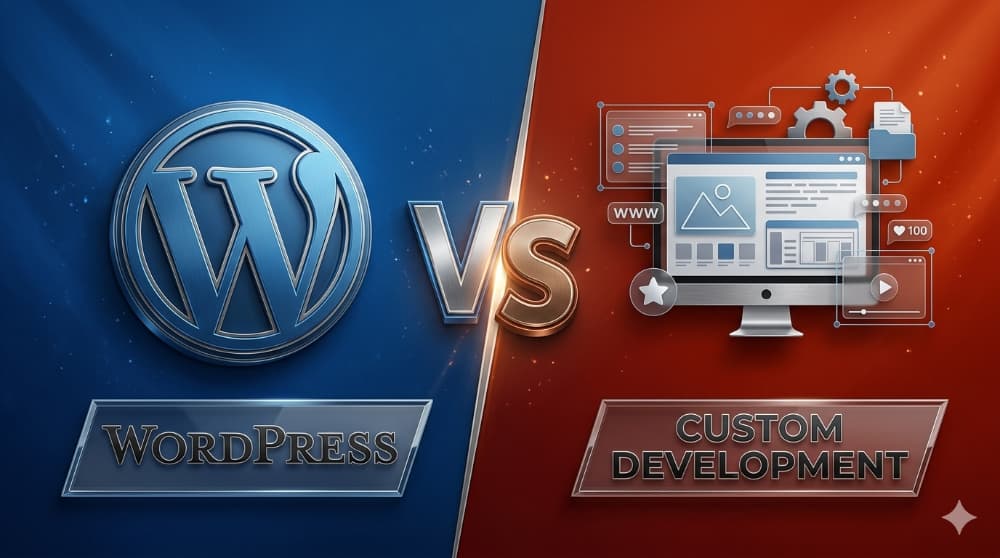
WordPress vs. Custom Website: Which Is Better for Your Business?
 Ama Powell
Every Nigerian business owner eventually faces this question. You've decided you need a proper website — not just a landing page slapped together over a weekend — and someone in your network says "just use WordPress." Then someone else says "no, build something custom." Then a third person says neither, try Wix.
Now you're confused. You don't want to make the wrong call and spend money twice.
Here's the truth: there is no single right answer. WordPress is not always the best choice. Custom development is not always better. The right option for you depends entirely on what your business actually needs — and most people making this decision don't have the information to figure that out before they've already committed.
This article gives you that information. We're going to break down what each option actually means, what it costs in the Nigerian market, where each one shines and where it fails, and how to decide without second-guessing yourself afterwards.
First, Let's Define the Terms Properly
WordPress is a Content Management System (CMS). Think of it as a ready-built house — the structure is already there, and you move in by customising the interior. You pick a theme (the visual design), add plugins (software extensions that add features), and fill in your content. No coding required. Over 40% of all websites on the internet run on WordPress, which tells you it's not a toy.
A custom website is built from the ground up — from an empty room. A developer (or team of developers) writes every line of code specifically for your business, using programming frameworks like Laravel, Next.js, React, or Django. Nothing is borrowed. Everything is built.
Both are legitimate. Both can produce excellent results. The question is which one fits your situation.
The Case for WordPress
Speed to Launch
A well-organised WordPress project can go from brief to live website in two to four weeks. For a business that needs to be online quickly — for a pitch, a launch event, a new service — that speed is genuinely valuable. A custom build for the same scope typically takes two to four months minimum.
Lower Entry Cost
In the Nigerian market today, a professionally built WordPress website starts from around ₦150,000 and can comfortably deliver a solid small business site in the ₦350,000–₦700,000 range. An equivalent custom-built site starts from ₦1.5 million and typically runs considerably higher. For a small business or startup, that difference is significant.
You Can Update It Yourself
WordPress has a dashboard designed for non-technical users. Once your developer hands the site over, you can log in and change your service offerings, update your pricing, add new photos, or publish a blog post without calling anyone. That independence is worth something, especially in Nigeria where chasing a developer for small updates is an experience most business owners have suffered through at least once.
The Plugin Ecosystem
Need a booking system? There's a plugin. Appointment scheduling? Plugin. WhatsApp chat button? Plugin. SEO tools? Plugin. Live chat? Plugin. For most standard business needs, something already exists that can be installed and configured — no custom code needed. This is WordPress's biggest structural advantage. You're buying into decades of third-party software built for exactly the things you need.
WordPress Is Built for Content
If your business involves publishing regular content — blog posts, news, guides, case studies — WordPress's content management tools are genuinely excellent. Adding new pages, formatting content, scheduling posts, managing media — all of it works smoothly and is designed for people who are not developers.
The Case for a Custom Website
It Does Exactly What You Need — Nothing More, Nothing Less
WordPress sites inevitably carry weight they don't need. Plugins you're not using, code running in the background, themes loading assets for features you haven't enabled. A custom-built website is lean. Every piece of code exists for a reason. The result is typically faster page loads, cleaner architecture, and fewer moving parts that can break unexpectedly.
Security Advantages
Because WordPress powers such a huge portion of the internet, it is permanently on the radar of hackers looking for vulnerabilities. Not because WordPress is badly built, but because the scale of the target makes it attractive. A custom site, built on its own codebase with no publicly known architecture, is a smaller and less obvious target. For financial services, healthcare platforms, or any business handling sensitive user data, this matters more than most people realise.
No Plugin Dependency
Every WordPress plugin you rely on was built by a third party. Some are brilliantly maintained. Others are abandoned, infrequently updated, or acquired by companies with different priorities. A plugin conflict — two plugins that don't play nicely together — can break a live website with zero warning. With a custom build, your developers own all the code. There are no third-party dependencies controlling your site's stability.
Built for Scale and Complexity
If your business model requires something that doesn't exist as a plugin — a custom marketplace where buyers and sellers interact, a subscription platform with complex tier logic, a booking engine with unique rules, a web application that integrates with multiple Nigerian payment systems and an internal ERP — WordPress cannot get you there cleanly. Custom development is the only path.
Long-Term Performance Under Load
WordPress with good hosting handles most Nigerian business websites comfortably. But when traffic scales significantly — tens or hundreds of thousands of monthly visitors, complex database queries, high transaction volumes — a purpose-built custom architecture will outperform a plugin-heavy WordPress setup. For startups building toward that scale, the architectural decisions made early matter later.
Where Each One Falls Short
Being balanced means saying the uncomfortable things too.
WordPress weaknesses:
Can become slow and bloated if poorly managed — too many plugins, unoptimised images, cheap hosting
Requires regular updates (WordPress core, themes, plugins) that can occasionally break things
Highly customised WordPress sites can become difficult to maintain when the original developer hands off to someone else
Dollar-denominated premium plugins and themes become more expensive as the naira weakens
Custom development weaknesses:
Significantly more expensive upfront — not the right call for most small Nigerian businesses starting out
Takes longer to build and launch
You are entirely dependent on your developers for updates and changes — no dashboard for self-management unless one is built for you
Finding genuinely skilled custom developers in Nigeria is harder and the talent pool is smaller
The Nigerian Context: What Matters Here Specifically
A few things about the Nigerian market that shape this decision:
Naira and dollar costs. Many premium WordPress themes and plugins are priced in US dollars. At current exchange rates, a single $99 plugin costs approximately ₦150,000 annually. A site running four or five premium plugins starts to carry a recurring dollar cost that can be painful when the naira slides. Custom-built features, once built, have no annual dollar subscription attached to them.
Maintenance availability. WordPress developers are everywhere in Nigeria — from Kaduna to Port Harcourt to Ibadan. If your original developer becomes unavailable, finding someone to maintain your WordPress site is relatively straightforward. Finding a developer fluent in the specific custom framework your previous team used is considerably harder. If you go custom, the choice of technology stack matters, and you should ask your developer about long-term maintenance explicitly.
Power and connectivity. Nigerian internet conditions vary. A WordPress site poorly set up on cheap hosting and loaded with unoptimised images will load painfully on mobile data. But a well-configured WordPress site — on good hosting, with image compression, caching, and a CDN — performs excellently. The platform is not the ceiling; the implementation is. The same is true for custom sites.
Local payment integration. Paystack and Flutterwave are both well-supported on WordPress via official plugins. For straightforward e-commerce or payment collection, WordPress handles this without needing custom development. More complex payment logic — multi-vendor splits, subscription billing with custom cycles, USSD integration — typically requires custom code regardless of which platform you start from.
The Head-to-Head Comparison
Factor | WordPress | Custom Website |
|---|---|---|
Cost to build | ₦150,000 – ₦1,500,000 | ₦1,500,000 – ₦20,000,000+ |
Time to launch | 2–6 weeks | 2–6 months |
Ease of self-management | High — built for non-developers | Low — requires developer involvement |
Design flexibility | Medium — theme constraints apply | High — anything is possible |
Performance ceiling | Good with proper setup | Excellent |
Security | Good, requires active maintenance | Stronger, smaller attack surface |
Scalability | Good for most Nigerian businesses | Better for high-scale or complex platforms |
Ongoing costs | Hosting + plugin subscriptions | Hosting + developer retainer for changes |
Finding maintenance support | Easy | Harder — depends on tech stack |
Built for unique functionality | Limited | No limits |
So, Which One Should You Choose?
Here's the clearest framework we can offer:
Choose WordPress if:
You're a small to medium business needing a professional online presence, e-commerce store, or content site
Budget is a genuine consideration and you need to allocate it wisely
You want to be able to update your own content without calling a developer
You need to be live quickly
Your functionality needs are standard — pages, contact forms, portfolio, blog, basic e-commerce
You have fewer than 100,000 monthly visitors (WordPress handles this with ease)
Choose custom development if:
You're building a platform, marketplace, or web application — not just a website
Your business logic is genuinely unique and can't be replicated with existing plugins
Security is paramount — you're handling financial data, medical records, or sensitive user information
You're a funded startup building toward significant scale and need a technical foundation that grows with you
You have the budget and the timeline
The honest middle ground: Most Nigerian businesses asking "WordPress or custom?" should be on WordPress. The businesses that genuinely need custom development usually already know they do, because what they're building cannot be described simply as "a website."
A Word on the Decision Nobody Mentions
The worst outcome isn't choosing WordPress when you needed custom, or vice versa. It's choosing wrong because the person advising you had a financial incentive in the answer.
A developer who only does custom work will find reasons custom is better. An agency that primarily does WordPress will find reasons WordPress is fine. The right agency for your project is one that builds both, has no preference between them, and asks enough questions about your business to recommend the right fit without pitching you.
At Busyexpand, we build both. WordPress when it's the right tool. Custom when it's not. And we'll tell you which one we think you need after we understand what you're actually trying to build — not before.
If you're not sure which direction makes sense for your business, start a conversation with us. We'll give you a straight answer.
Published by Busyexpand Enterprises — A digital agency helping Nigerian businesses grow on the web. busyexpand.com | Port Harcourt, Nigeria
Related Articles
Explore more articles from the same category and tags