How to Choose a Software Development Company in Nigeria
 Ama Powell
Nigeria has one of the fastest-growing developer communities in the world. GitHub's Octoverse 2024 counted more than 1.1 million Nigerian developers on its platform, up 28% year on year (GitHub). That's good news if you're hiring: there's real talent and plenty of choice. It also means more noise, so picking the right partner takes a method, not a gut feeling.
This is the method we'd use if we were on your side of the table. It works whether you're a Port Harcourt business building your first app or a London startup hiring a Nigerian team.
Step 1: Decide what kind of partner you need
Before comparing companies, decide what kind of partner fits the job:
Your situation | Usually the best fit |
|---|---|
A small, well-defined task with a clear end (a landing page, one feature, a fix) | A freelancer |
A complete product that someone must be accountable for, from design to launch | A software development company working on a fixed scope |
A live product with a roadmap, changing priorities and steady work | A dedicated product team |
You're not sure yet what you need | A short, paid discovery or scoping phase first |
Freelancers can be excellent, but everything depends on one person's availability and skill range. A company gives you design, engineering, testing and project management under one contract. A dedicated team gives you continuity over months, not a single delivery. If you're unsure which applies to you, read 5 Signs You're Ready for a Dedicated Product Team (And 3 Signs You're Not).
Step 2: Write a one-page brief
You'll get better proposals, and comparable ones, if every company is answering the same brief. Keep it to one page:
The problem. What's broken or missing today, and for whom?
The users. Who will use it, and on what devices?
The first journey. The single task the product must get right in its first release.
Integrations. Payments, existing software, data you already have.
Constraints. Deadline, budget range, compliance needs.
What success looks like six to twelve months after launch.
If you can't fill this page in, that's your answer: start with a paid discovery phase, not a build.
Step 3: Build a shortlist of three to five
Referrals from founders you trust are the best source. Search results and directories come next. For each candidate, check:
Live, relevant work. Open the apps and websites on your own phone. Do they load fast and work properly? Does the company have work similar in complexity to yours, even if it's in a different industry?
A real team. Named people you can look up, not a vague "global network".
Clear services. Do they actually do what you need (web apps, mobile apps, custom business software, maintenance), or do they list everything?
Location is now less important than communication. A Port Harcourt team can serve a client in Lagos or Manchester equally well if the working hours overlap and the process is clear.
Step 4: Use the first call to test how they think
The first call tells you more than any portfolio. Good partners ask before they quote. They want to understand your users, permissions, data, edge cases and what success means. A firm that gives you a fixed price in the first ten minutes is guessing.
Listen for whether they: - Push back on something in your brief, with a reason. - Suggest a smaller first release. - Explain trade-offs in plain language. - Tell you who will actually do the work.
We've published the five questions we think you should ask any agency, with our own answers. Use them on everyone, including us.
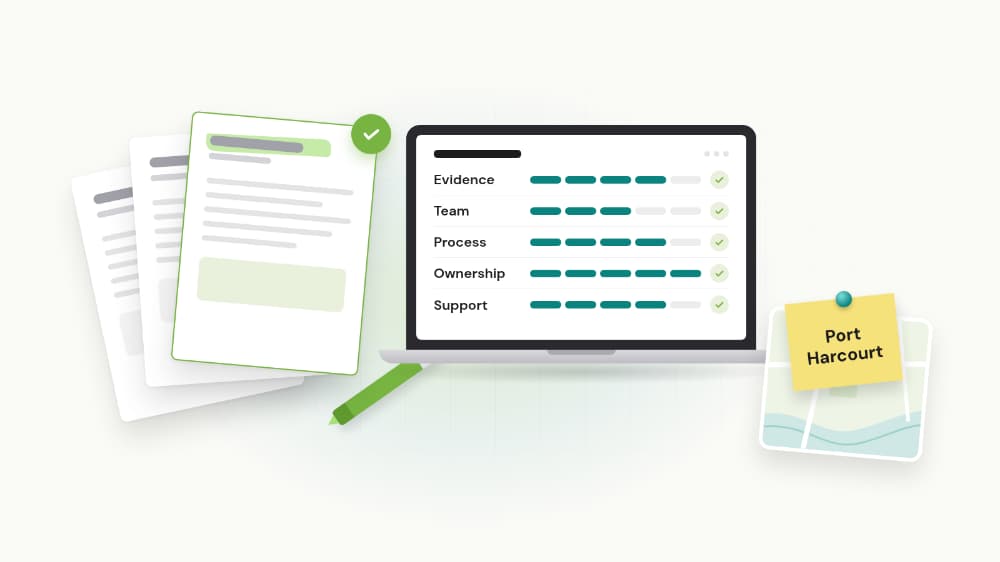
Step 5: Compare proposals by scope, not headline price
Put the proposals side by side and score each against the same criteria:
Criterion | What good looks like |
|---|---|
Scope | Written, itemised, with clear exclusions |
Team | Named roles, and the people you met are the people doing the work |
Process | Regular demos, written progress updates, a defined way to handle changes |
Quality | Code review, testing, separate staging and live environments |
Ownership | You own the code, design files and accounts |
Support | What happens after launch, for how long, at what cost |
Payment | Milestones tied to delivered work, not a large upfront payment |
The lowest quote often excludes design, testing, deployment, store submission or support. When it does, the price is only lower because those costs are hidden and will show up later.
Step 6: Check ownership and accounts before you sign
This is where expensive mistakes happen. Before any work starts, confirm in writing that:
Source code lives in a repository you own, or is transferred to you in full.
Domain, hosting, cloud and payment accounts are registered to your business.
App store accounts are in your company's name. Apple requires an organisation to be a legal entity with a D-U-N-S Number, a public website and a work email on your domain before the company can be listed as the seller (Apple). Google Play offers separate personal and organisation accounts and may ask for government ID (Google).
Documentation and handover are included, so another team could take over if needed.
An NDA is available before you share anything sensitive.
Step 7: Ask how they protect data
If your product stores customer, employee, financial or health data, "we use SSL" isn't a security plan. Ask about access control, backups, separate environments, how secrets are stored and what happens after a breach. For products serving Nigerian users, your partner should understand the Nigeria Data Protection Act 2023, the law that governs personal data processing in Nigeria and established the Nigeria Data Protection Commission (NDPC). International clients will also have their own obligations at home, so make sure the contract covers both.
Step 8: Start with a paid pilot
For anything significant, don't commit to the whole project at once. Start with a short, paid first phase: a discovery sprint, one feature or a clickable prototype. Within a few weeks you'll learn how the team communicates, how accurate their estimates are and whether the work quality matches the pitch. If it doesn't work out, you've lost weeks, not a year.
Extra checks for international clients
If you're hiring a Nigerian company from abroad, also confirm:
Working-hour overlap. Nigeria runs on WAT (UTC+1), which overlaps well with UK and European hours and partly with US Eastern time.
Payments and invoicing. Which currency they invoice in and from which entity. We explain how this works in How Nigerian Devs Actually Get Paid.
Communication rhythm. Weekly calls, written reports and sprint demos you can attend. Here's how we run a sprint.
Governing law and how disputes are resolved.
Red flags
A fixed price before they understand your product.
No live work you can open.
They won't say who's on the team.
The contract is vague about who owns the code.
Most of the payment is due upfront.
No answer to "what happens after launch?"
Where Busyexpand fits
Busyexpand is a digital product company based in Port Harcourt that has shipped 20+ digital products for businesses and founders in Nigeria and internationally. Our portfolio shows some of them. We design, build and maintain web apps, mobile apps and custom business software, with ongoing Product Care after launch. Clients who want continuity work with a Dedicated Product Team. We work across WAT, GMT, CET and EST, invoice in GBP, EUR or USD, and will counter-sign a mutual NDA before the first call (Contact).
If we're not the right fit, we'll tell you.
FAQ
What should I look for in a software development company in Nigeria?
Live, relevant work. A named team. A clear process with regular demos. Written scope. Explicit ownership of code and accounts. A defined plan for support after launch.
Should I hire a freelancer or a company?
A freelancer suits a small, clearly defined task. A company suits a full product where you need design, engineering, testing and one accountable party. A dedicated team suits ongoing work with a roadmap.
How do I avoid getting scammed by a developer?
Pay against milestones, not upfront. Keep code, domains, hosting and store accounts in your business's name. Start with a small paid pilot before committing to the full build.
Who should own the source code?
You should. The contract should assign full ownership of code and design files to you, with repository access and handover documentation.
Can a Port Harcourt company serve clients in Lagos, Abuja or abroad?
Yes. Most delivery happens remotely. What matters is time-zone overlap, communication and process, not the office address.
How long does it take to choose a development partner?
Leave yourself a few weeks: a week or two to brief and shortlist, a week of calls and proposals, then a short paid pilot before signing for the full build.
Do Nigerian software companies sign NDAs?
Reputable ones do. Busyexpand will counter-sign a mutual NDA before the first call.
Talk to us before you decide
Send us your one-page brief, even if it's rough. We'll reply with honest questions, a view on scope and the right next step, whether that's working with us or not. Start a project or book a call at busyexpand.com.
Sources
GitHub, "Octoverse 2024" (Africa table: Nigeria 28% YoY, >1.1M developers): https://github.blog/news-insights/octoverse/octoverse-2024/
Apple Developer, Program enrollment: https://developer.apple.com/support/enrollment/
Google, Get started with Play Console: https://support.google.com/googleplay/android-developer/answer/6112435?hl=en
Nigeria Data Protection Commission, About Us: https://ndpc.gov.ng/about-us/
Busyexpand Services and Contact pages: https://www.busyexpand.com/services · https://www.busyexpand.com/contact-us
Was this article helpful?
More articles like this
 Software Development
Oct 23, 2026 · 8 min read
Mobile App Development Cost in Nigeria: 2026 Guide
 Software Development
Aug 5, 2026 · 3 min read
The 'MVP' You Were Sold Was Actually Just an Unfinished Product
"MVP" has become the most convenient word in software development, and not in a good way. It used to mean something specific. Now it mostly means "we ran out of time, budget, or discipline, and we're calling the result a strategy instead of what it actually is."
 Software Development
Aug 5, 2026 · 4 min read
What Our First 90 Days With a New Client Actually Look Like
Founders ask us this in a roundabout way almost every time — not "what's your onboarding process," but something closer to "what actually happens after I say yes." Fair question.