Mobile App Development Cost in Nigeria: 2026 Guide
 Ama Powell
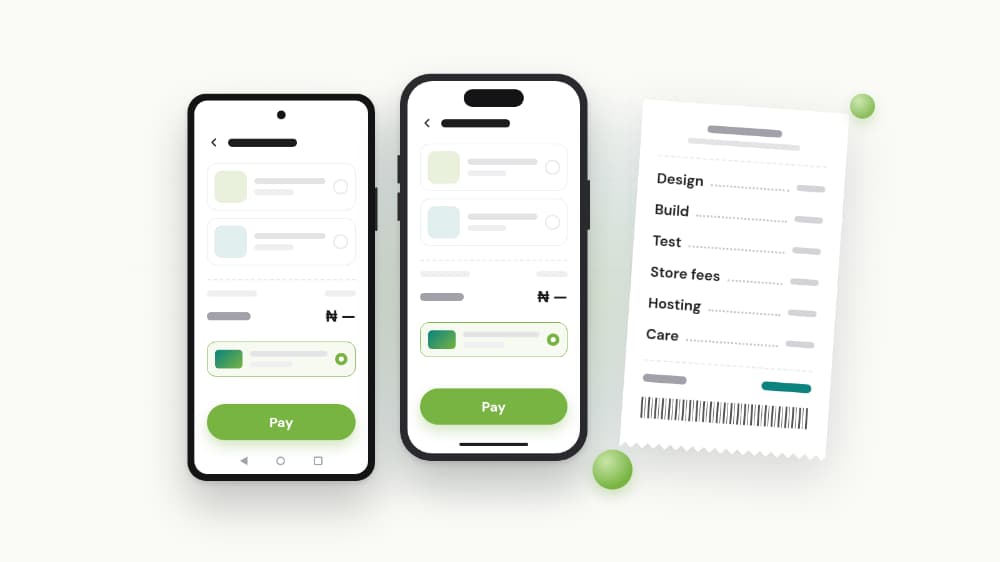
"How much for an app?" is usually the first question we get, and the honest answer has two parts: what it costs to build and what it costs to run. Most quotes only cover the first. This guide covers both, using published market ranges and official fee pages, so you can plan a realistic budget whether you're in Port Harcourt, Lagos, Accra or London.
The short answer
Published 2026 guides from Nigerian agencies put a custom mobile app at roughly ₦1.5 million for a lean MVP and ₦25 million or more for a complex product. Nivarix Technologies breaks it down like this (source):
Project type | Indicative budget | Typical timeline |
|---|---|---|
Lean MVP or simple app | ₦1.5m – ₦4m | 6–12 weeks |
Standard business app | ₦4m – ₦10m | 2–4 months |
Complex multi-role app | ₦10m – ₦25m+ | 4–8 months |
Enterprise or regulated platform | Scope-based | 6–12+ months |
Treat these as planning ranges, not prices. The source itself says a proper quote should only come after the requirements, user flows and integrations are understood. Your number depends on what the app actually has to do.
What actually drives the price
Screen count barely matters. These factors move the number:
1. Business logic, not screens
A content app that shows menus or articles is a very different build from a wallet, a marketplace or a delivery app. Two apps can share a design and still differ several times over in engineering effort. The difference is in the rules: who can do what, when money moves, and what happens when something fails halfway.
2. User roles
Each new type of user (customer, rider, vendor, admin) brings its own screens, permissions and edge cases. A delivery app is usually three products in one: the customer app, the rider app and the operations dashboard.
3. The backend and admin tools
The phone app is only part of the product. Most serious apps also need an API, a database, an admin panel, reporting and permissions behind the scenes. A quote that doesn't mention the backend is either for a very simple app or incomplete.
4. Integrations
Payments, maps, SMS and OTP, email, identity verification and accounting tools all add engineering and testing time. In Nigeria, payments usually mean Paystack or Flutterwave. Building the integration is a one-off cost, but transaction fees recur. Paystack, for example, publishes local transaction fees of 1.5% + ₦100, capped at ₦2,000, and international cards at 3.9% + ₦100 (Paystack pricing). Factor that into your margins, not just your build budget.
5. Platforms: Android, iOS or both
Building for Android only usually costs less than building and maintaining two separate native apps. Cross-platform frameworks such as Flutter or React Native let one team target both from a single codebase. They aren't automatically cheaper once you add device-specific work, but for most business apps they're the sensible default. If your customers are mostly on Android, launching there first is a legitimate way to control cost.
6. Design depth
Template UI is cheaper. A custom product design costs more up front but tends to reduce confusion, support tickets and drop-off. Budget design as a real line item, not an afterthought.
7. Security and data
If your app handles payments, health data, IDs or other sensitive information, expect stronger access controls, logging and review. In Nigeria, the Nigeria Data Protection Act 2023, signed on 12 June 2023, sets the legal framework for handling personal data and established the Nigeria Data Protection Commission to enforce it (NDPC). Building privacy in from the start is cheaper than retrofitting it.
The running costs most quotes leave out
Build cost is what you pay once. These are what you keep paying:
Store accounts. Apple's Developer Program costs US$99 per year (Apple). Google Play charges a one-time US$25 registration fee (Google Play Console Help). Both fees are in dollars, so you'll need a card that can pay in USD.
Hosting and databases. Servers, storage and backups are billed monthly and grow with your users.
Usage-based services. SMS and OTP, push notifications, maps, email and AI features are usually metered per message, request or user.
Monitoring and analytics. Error tracking and analytics tools so you know when something breaks before your customers tell you.
Maintenance. iOS and Android keep shipping updates, libraries get deprecated and security patches keep coming. An app nobody looks after slowly stops working. We cover this in What Happens After Launch: The 12 Months Nobody Talks About.
The next features. Real users will ask for things you didn't plan. Keep a budget line for them.
Plan the store accounts early
Store accounts take time, not just money. To publish under your company name, Apple requires your organisation to be a legal entity with a D-U-N-S Number, a working website on your own domain and a work email on that domain (Apple). Google may ask for government ID, and new personal Play accounts must meet testing requirements before they can publish (Google). Start these early, and make sure the accounts are registered to your business, not to your developer.
How to keep the cost under control (without cutting the wrong corners)
Define one complete user journey first. Write down how a user signs up, completes the main task, gets confirmation and gets help if something fails. Then describe what your admin needs to see. That's your first release.
Separate "launch" from "later." Make two lists. Anything not needed to prove the core idea goes on the second one. A small, well-built first release beats a large, half-finished one. We've written about why the "MVP" you were sold was often just an unfinished product.
Check that you need an app at all. If customers visit occasionally, a fast web app may validate demand for less. Our guide Website, Web App, or Mobile App? walks through the decision. If a web app fits, see How Much Should You Actually Budget for a Web App in 2026?
Use proven services for commodity features. Payments, auth, maps and messaging already exist. Pay to integrate them well, not to reinvent them.
Ask for an itemised quote. It should show design, build, testing, deployment, store submission and post-launch support as separate lines, along with what's excluded.
Budget for care from day one. Decide before launch who maintains the app and how that's paid for.
How to compare two app quotes
Two quotes for "the same app" can differ wildly. Before choosing on price, put them side by side and check:
Does each include the backend and admin dashboard, or only the phone app?
Is testing on real devices included?
Who handles App Store and Play Store submission?
Who owns the source code, the store accounts and the hosting?
What happens after launch: for how long, and at what cost?
Is the scope written down, with a process for changes?
A lower quote that leaves out half of this list isn't cheaper. It just moves the costs to later.
How Busyexpand prices mobile app work
Busyexpand is a digital product company in Port Harcourt that has shipped 20+ digital products for clients in Nigeria and abroad. You can see some of them in our portfolio. We build mobile apps, web apps and ongoing Product Care, and we work with clients across WAT, GMT, CET and EST, invoicing in GBP, EUR or USD (Contact).
We price in engagement cycles rather than by screen. Our public Dedicated Product Team plans start at $5,000 for a four-week cycle with one or two developers, which suits validating an idea or a single feature. The Advance plan, at $25,000, covers a six-to-eight-week cycle with a cross-functional frontend, backend and UI/UX team, structured QA and a delivery manager. Larger products get a scoped Scale plan. Every quote starts with understanding your users and your first journey.
FAQ
How much does a simple app cost in Nigeria?
Published 2026 market guides put a lean MVP or simple app at around ₦1.5m–₦4m, typically over 6–12 weeks (Nivarix). The final figure depends on features, integrations and whether you need one platform or two.
Can I build an app for less than ₦1 million?
Possibly, for a small prototype, a template-based product or a no-code test. A custom production app with a backend, testing and deployment usually needs a larger budget.
Is it cheaper to build for Android only?
Usually, yes. One platform means less to build, test and maintain. If most of your customers use Android, a common approach is to launch there first and add iOS once demand is proven.
What are the yearly costs of running an app?
At minimum: Apple's US$99 annual developer fee if you're on iOS, plus hosting, usage-based services (SMS, maps, notifications), monitoring and maintenance. Google Play's US$25 fee is one-time.
How long does it take to build a mobile app?
A focused MVP often takes around 6–12 weeks. Apps with several user roles, payments and integrations can take several months.
Do I own the app and the code?
You should, and your contract should say so explicitly. Make sure the source code repository, store accounts and hosting are all in your business's name.
Can an international client hire a Nigerian team?
Yes. Ask about time-zone overlap, payment currency and contracts up front. Busyexpand works across WAT, GMT, CET and EST, invoices in GBP, EUR and USD, and will sign a mutual NDA before the first call (Contact).
Get a realistic number for your app
Send us a short note about who the app is for and the one journey it has to get right, and we'll come back with an honest view of scope, timeline and budget. Start a project or book a call at busyexpand.com.
Sources
Nivarix Technologies, "How Much Does It Cost to Build a Mobile App in Nigeria in 2026?" (28 Sep 2026): https://nivarix.com/insights/mobile-app-development-cost-nigeria-2026
Paystack, Pricing: https://paystack.com/pricing
Apple Developer, Program enrollment: https://developer.apple.com/support/enrollment/
Google, Get started with Play Console: https://support.google.com/googleplay/android-developer/answer/6112435?hl=en
Nigeria Data Protection Commission, About Us: https://ndpc.gov.ng/about-us/
Busyexpand Services and Contact pages: https://www.busyexpand.com/services · https://www.busyexpand.com/contact-us
Was this article helpful?
More articles like this
 Software Development
Oct 23, 2026 · 8 min read
How to Choose a Software Development Company in Nigeria
 Software Development
Aug 5, 2026 · 3 min read
The 'MVP' You Were Sold Was Actually Just an Unfinished Product
"MVP" has become the most convenient word in software development, and not in a good way. It used to mean something specific. Now it mostly means "we ran out of time, budget, or discipline, and we're calling the result a strategy instead of what it actually is."
 Software Development
Aug 5, 2026 · 4 min read
What Our First 90 Days With a New Client Actually Look Like
Founders ask us this in a roundabout way almost every time — not "what's your onboarding process," but something closer to "what actually happens after I say yes." Fair question.