App Brief Template: How to Write One Developers Can Quote On
 Ama Powell
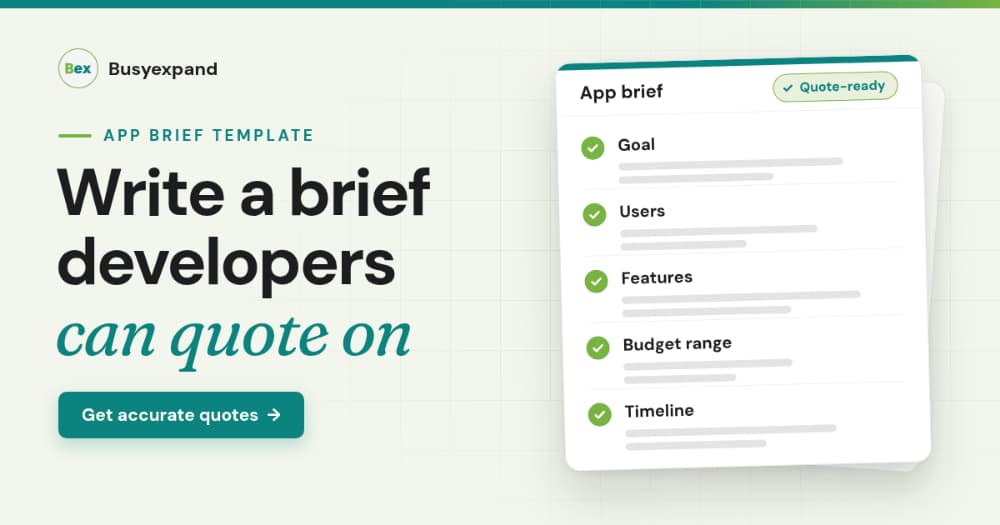
Short answer: a brief developers can quote on is two to five pages that state your goal, your users, a short must-have list, your platforms, every integration, your constraints, a budget range, a date and how you will measure success. It also says what is out of scope. Copy the template below, fill every line, and send the same document to every developer you ask.
A thin brief such as "we need an app like Uber for my city" gets quotes that differ wildly, because each developer fills the gaps with their own assumptions. Innovation Insight, a software firm that publishes an RFP template, puts it simply: "Vendors price uncertainty," so each blank becomes a risk margin in the quote or a question you answer by email. This guide shows what to write, what to skip, and how a brief becomes a fixed scope and a quote.
What a quotable brief contains
Guides differ on headings. Atlassian's product requirements template covers goals, assumptions, user stories, open questions and "what we're not doing". Acquaint Softtech, a software vendor, uses seven sections. Innovation Insight's template has thirteen. For an app, ten items matter.
1. Goal. Write the business outcome and how you will measure it, not a feature list. Innovation Insight contrasts "Reduce manual order entry by 80 percent", which tells a developer what to optimise for, with "build an order portal", which does not. If you can only describe features, spend a few days on the problem first.
2. Users and roles. List each type of user, roughly how many, and what each does. Roles drive permissions, and permissions drive a surprising share of the build. A customer app, a rider app and an admin dashboard are three products, not one.
3. Features, ranked. Don't hand over one long list. The Agile Business Consortium describes MoSCoW from the DSDM method: Must Have, Should Have, Could Have and Won't Have this time. Its test for a Must Have is to ask what happens if this requirement is not met? If the answer is "cancel the project", it is a Must Have. If there is a workaround, even a manual one, it is not. DSDM suggests Must Haves typically take no more than 60% of the effort, which leaves room for contingency. If everything is a Must Have, break features down further. Add one line per Must Have saying what "done" looks like. "Customers can pay by card or transfer and see a receipt" is quotable. "Payments" is not.
4. Platforms. State where it must run: Android, iOS, web, an admin panel. If you are unsure, describe your customers and ask the developer to recommend, and read Android, iOS or both? first. For context, Statcounter recorded Android at 84.21% of Nigerian mobile page views in September 2026. That is web traffic, not your customers, so check your own data first.
5. Integrations. "Standard integrations" produces quotes that omit what you consider standard. Acquaint Softtech notes that each integration is its own scoping item. For each system, say what it is, whether data flows in, out or both, and who holds the credentials. In Nigeria, payments usually means Paystack or Flutterwave. Paystack lists local card fees of 1.5% + ₦100, capped at ₦2,000, and says integration costs nothing. The gateway is free to connect. The developer's time to build, test and reconcile payments is not. Say who bears transaction fees, and see our payment integration guide.
6. Content and admin needs. Most apps need a back office. Say who adds products, approves users, issues refunds, exports reports and edits content. A quote that ignores the admin panel is either for a very simple app or incomplete.
7. Constraints. List anything fixed: hosting location, regulators, an existing system, offline use on poor networks. Mark preferences as negotiable. If you don't know an answer, Acquaint Softtech suggests writing what you know and flagging the gap as a working assumption.
8. Budget range. Founders often skip this for fear of anchoring the price. Both vendor sources argue for including it. Innovation Insight says vendors who know the band propose a scope that fits it instead of guessing. Acquaint Softtech calls a range "a shared scope boundary", not an anchor. Say whether it is firm or exploratory. Our mobile app cost guide helps you set a realistic band.
9. Timeline. Give the date, whether it is fixed, and why. A launch tied to a campaign is scoped differently from "when it's ready". Say what a minimum launch looks like if everything cannot fit.
10. Success measures. Use numbers you can check, such as orders completed per week or the share of payments that succeed. "Fast" is not a measure. "Order screen loads in under three seconds on a mid-range Android phone" is.
What to leave out
A full specification. Acquaint Softtech says a brief gets initial quotes, while a technical specification comes after you choose a developer and finish discovery. Past five pages, your brief has probably become a spec.
Technology choices you don't need. Describe what the product does and leave how it is built to the developer, unless something is a real constraint.
A feature list copied from a competitor. Innovation Insight lists this as a common mistake, since it does not say what your first release must do.
Adjectives instead of numbers. "Modern", "fast" and "simple" cannot be quoted.
A demand for a fixed price on an undefined scope. Innovation Insight advises asking for a priced discovery phase instead.
Confidential material. Offer wireframes or documents under NDA rather than pasting them in.
Copy-paste template
Copy this into a document, fill each line, and delete the guidance. Aim for two to five pages in total.
Section | What to write | Your answer |
|---|---|---|
Company and contact | Who you are, who decides, who answers questions | |
One-line description | What you want built, in one sentence | |
Why now | The business trigger | |
Goal and success measure | Outcome plus a number, checked six months after launch | |
Users and roles | Role, how many, what they do, device | |
Must-have features | One line each, with what "done" looks like | |
Should-have / could-have | Ranked list for later phases | |
Out of scope | What you decided not to include this phase | |
Platforms | Android, iOS, web, admin panel | |
Integrations | System, direction of data, who owns credentials | |
Payments | Provider, currencies, who pays gateway fees | |
Content and admin | Who manages what after launch | |
Constraints | Legal, hosting, offline, existing systems | |
Budget | ₦____ to ₦____, firm or exploratory | |
Timeline | Date, fixed or flexible, reason | |
After launch | Who hosts, maintains and owns the accounts and code | |
Attachments | Wireframes, documents, links | |
Questions for developers | Team, process, references, assumptions |
The last row matters. Innovation Insight suggests asking every vendor to list the assumptions their price depends on and the three biggest risks they see.
Worked example (illustration only)
This is a made-up example for a fictional Port Harcourt delivery startup. It is not a client and the numbers are invented to show the level of detail, not what an app costs.
Section | Example answer |
|---|---|
One-line description | A mobile app that lets people in Port Harcourt order food and parcels and track the rider, plus a dashboard for our dispatcher |
Goal and success measure | Move order-taking off phone calls. Target: 70% of orders placed in the app within three months of launch |
Users and roles | Customer (about 2,000 in the first year), rider (about 40), dispatcher (2). Customers and riders on phones, dispatchers on a laptop |
Must-have features | Sign up with phone OTP; browse vendors and menus; place and pay for an order; live order status; rider accepts and updates delivery; dispatcher assigns and cancels orders |
Should / could have | Promo codes, ratings, scheduled orders, loyalty points |
Out of scope | Vendor self-service portal, multi-city support, in-app chat |
Platforms | Android first for customers and riders, web dashboard for dispatch. iOS to be decided after launch data |
Integrations | Paystack for card and transfer payments. SMS provider for OTP. Maps service for routing. Direction of data stated for each |
Constraints | Must work on weak mobile networks. Customer data held securely. Business owns all accounts |
Budget | ₦[low] to ₦[high], exploratory. We have not printed figures because any number here would read like a price |
Timeline | Launch before the December rush. Date fixed. If tight, launch customer ordering and payment first |
After launch | We own the store and hosting accounts. Need a support and maintenance plan |
It ranks features, excludes things on purpose, names every integration and has a fallback launch plan.
How a brief becomes a fixed scope and a quote
A quote is the end of a short chain, not the start.
Developers read the brief and ask questions. Good ones ask before they quote. Our guide on choosing a software development company explains why a firm that gives a fixed price in the first call should worry you.
Unclear scope goes into a paid discovery phase. Innovation Insight recommends a priced discovery phase when the backlog does not exist yet.
Must-haves become the fixed scope. The Must Have list for the first release is what a fixed price covers. Should and Could Haves become options or later phases, and Won't Haves stay written down so they are not quietly added.
The quote lists assumptions and exclusions. Look for what it assumes about integrations, users and devices. Anything outside it is a change request.
Changes get documented. Atlassian warns that documentation goes stale, and Acquaint Softtech says scope changes belong in a brief update or formal change request.
At Busyexpand, every quote starts with understanding your users and your first journey. Our public Dedicated Product Team plans start at $5,000 for a four-week cycle with one or two developers, which suits validating one feature, and $25,000 for a six-to-eight-week cycle with a cross-functional team. An MVP that is only half-built is a risk, so read The MVP You Were Sold before you sign.
FAQ
How long should an app brief be?
Two to five pages. Innovation Insight says two to six pages is normal for a request for proposal, and Acquaint Softtech says most complete briefs run two to five. Attach wireframes rather than describing them.
Should I send the same brief to every developer?
Yes. Acquaint Softtech says identical briefs are the only way to compare like with like. Innovation Insight suggests three to five vendors.
What if I don't know all the answers?
Write what you know and mark the rest as an assumption. A flagged assumption is more useful than a blank.
Send us your brief
Not sure it is complete? Send us what you have and we will tell you what is missing before you ask anyone for a quote. Start a project or book a strategy call at busyexpand.com. See our services. Busyexpand is a Port Harcourt digital product company that has shipped 20+ digital products.
Sources
All opened on 27 October 2026 (Africa/Lagos). Acquaint Softtech and Innovation Insight are software vendors; their guidance is attributed to them, not presented as industry statistics. - Agile Business Consortium, What is MoSCoW Prioritization? (published 28 May 2026): https://www.agilebusiness.org/resource/what-is-moscow-prioritization/ - Atlassian, How to create a product requirements document (PRD): https://www.atlassian.com/agile/product-management/requirements - Acquaint Softtech, How to Write a Software Development Brief (13 April 2026): https://acquaintsoft.com/blog/how-to-write-software-development-brief - Innovation Insight, Software Development RFP Template (updated 9 October 2026): https://www.innovation-insight.com/templates/software-rfp-template - Paystack, Pricing: https://paystack.com/pricing - Statcounter Global Stats, Mobile Operating System Market Share Nigeria, September 2026 (web page views, not sales or downloads): https://gs.statcounter.com/os-market-share/mobile/nigeria - Busyexpand, Services and Dedicated Product Team plans: https://www.busyexpand.com/services
Was this article helpful?
More articles like this
 Software Development
Oct 27, 2026 · 10 min read
Technical Debt Is a Loan: What Cheap Software Really Costs You
 Software Development
Oct 27, 2026 · 10 min read
Android, iOS or Both? Choosing Your First App Platform in Nigeria
 Software Development
Oct 26, 2026 · 8 min read